10th July 2008 ~ Leh – Alchi – Lamayuru
We got ready and had breakfast at the guest house itself. By the time we left Leh it was already 10.30.
We had our first photographic break after almost a half hour drive. And I thought taking a panorama ‘to banta hai’.

We went further and found a stretch of road where we saw the board about the magnetic hill.
Even we tried to check if our bolero moved on its own and sure it did!

The Indus, originates near the Kailash Mountain and the Mansarovar Lake in Western Tibet.
Water levels remain high during the month June to late August, which is the best season for fascinating rafting expeditions.
We saw a few people river rafting in the Indus waters.

We could see a confluence far ahead.

At the end of rafting, we saw people enjoying themselves in the river water flow.

Driving about 30kms west of Leh, we reached the confluence of the Indus and Zanskar River, 4km before Nimmu Village.
The confluence provided a magnificent view of the two rivers having different colours and force. This, at an altitude of 10,823ft.
The dark waters of Indus meet with the silt laden water Zanskar.

And all around there were lovely views of mountain ranges with different hues, as this one.

Moving further we saw these structures.

It was almost one and we saw another green patch between mountains and decided to stop over for a photography break.


We passed by wheat fields and I couldn’t stop myself from clicking.

And further ahead, the Alchi model village gate was welcoming us.

It was almost 2pm by the time we reached Alchi.


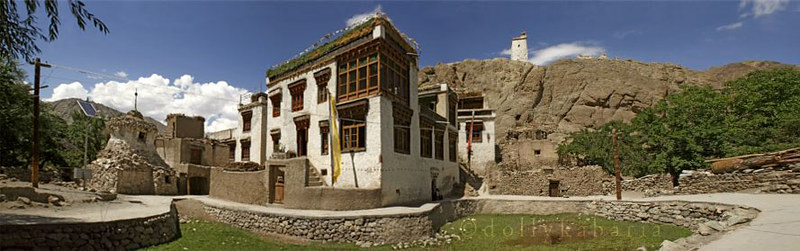
We had lunch in the market place before exploring the monastery. We passed by this house while going to the monastery.
And I remembered these lines.
This old house has seen the sunshine of many different years.
This old house has seen some happiness
This old house has seen some tears.
This old house now seems so empty since you left with last goodbyes.
The smiles and talk, the happy laughs
Echo above the lonely sighs whether leaves are green in springtime
snow leaves lightly on the ground
This old house will hold the memories of all the old families sounds.
~Edna Howard White

And this kid was playing in the front of his home.

Alchi is situated on the bank of Indus River 70 km downstream from the capital Leh. It is one of the earliest monasteries built in Ladakh, dating from the 11th century. Because it was constructed before the invading wars begun in the 15th century, Alchi was built on lowlands, rather than on a hilltop as other gompas were, to protect them from marauding armies.
The gompa at Alchi was erected by Rin-chen-Izghimpo, one of the first Ladakhi kings to engage in foreign relations. To build the monastery, the Ladakhi king signed a treaty with the Gyalpo (king) of Tibet, who agreed to provide the artisans.
The rambling monastery has six main buildings- the Dukhang or main assembly hall, the Sum-tsek or three-tiered temple; the adjoining Manjusri Lha-khang and Lotsawa Lha-Khang temples; the Lha-khang Soma and the Kanjur-Lha-khang.
Walking towards the gompa from the small group of houses nearby, the first temple of importance is the Sum-stek, the oldest of the Alchi gompa. The temple is surrounded by wooden pillars and carved woodwork of mythological animals. The middle arch portrays a seated Buddha with the Green Tara (the Saviouress) to the right and Vajrasattava, a Bodhisattva, to the left.

There were stairs which took us to place over looking river. I saw a guy enjoying kayaking in the river water.

Pradeep, Nitin and Sejal were also enjoying the view.

Spent some time in the market and decided to leave as it was almost 4.30pm

We left Alchi and started moving towards lamayuru. Evening light falling on mountains and road was creating a lovely story.


Mountain after mountain of the great Himalayan splendor passed us by.
Every one kilometer the scenes changed dramatically, and every frame looked like a picture postcard.

Have you ever seen a magenta coloured mountain?? I did.

There was an undulating series of mountains that's so unlike anything on earth that the Ladakhis call it 'moonland'. And verily they resemble the surface of the moon, with an ethereal look about them.

There is this mythology behind Lamayuru. A Buddhist lama by the name of Yuru was looking for a place to set up his monastery. When he reached this spectacular spot, he paused and said, 'It'll be here, my monastery.' But at that time the entire place was submerged under water, with just a few craggy peaks floating above it like glaciers. Lama Yuru, invoking his immense spiritual power, ordered the waters to recede and make place for his monastery. And recede they did.
The moonscape in Lamayuru looks exactly as if a massive river that was flowing through these mountains receded in a hurry, leaving behind uncanny forms of solidified silt.


I thought again – pano to banta hai.

After spending some good time clicking the moonland, we moved further. It was already past 6.30 and the light was fading rapidly.
We could already see Lamayuru monastery up on the hill ahead.

By 7.30 we reached Lamayuru. Checked into the 4-storey Niranjan Guest House adjoining the Gompa.
We had got a room on the corner of the top floor with huge windows and I thought we were going to have a lovely view of the sunrise.
Outside the room I could see last light of the day fading away.

It was indeed a beautiful evening.

Such play of varied colours were adorning the sky.

We decided to have dinner at the guest house itself. After dinner I went for a small walk. I was waiting for the stars to come up.
It was a lovely sight without light pollution. It looked as if it was raining stars.

After spending some time looking at stars, I decided to hit the bed; it was as such already eleven.
We got ready and had breakfast at the guest house itself. By the time we left Leh it was already 10.30.
We had our first photographic break after almost a half hour drive. And I thought taking a panorama ‘to banta hai’.

We went further and found a stretch of road where we saw the board about the magnetic hill.
Even we tried to check if our bolero moved on its own and sure it did!

The Indus, originates near the Kailash Mountain and the Mansarovar Lake in Western Tibet.
Water levels remain high during the month June to late August, which is the best season for fascinating rafting expeditions.
We saw a few people river rafting in the Indus waters.

We could see a confluence far ahead.

At the end of rafting, we saw people enjoying themselves in the river water flow.

Driving about 30kms west of Leh, we reached the confluence of the Indus and Zanskar River, 4km before Nimmu Village.
The confluence provided a magnificent view of the two rivers having different colours and force. This, at an altitude of 10,823ft.
The dark waters of Indus meet with the silt laden water Zanskar.

And all around there were lovely views of mountain ranges with different hues, as this one.

Moving further we saw these structures.

It was almost one and we saw another green patch between mountains and decided to stop over for a photography break.


We passed by wheat fields and I couldn’t stop myself from clicking.

And further ahead, the Alchi model village gate was welcoming us.

It was almost 2pm by the time we reached Alchi.


We had lunch in the market place before exploring the monastery. We passed by this house while going to the monastery.
And I remembered these lines.
This old house has seen the sunshine of many different years.
This old house has seen some happiness
This old house has seen some tears.
This old house now seems so empty since you left with last goodbyes.
The smiles and talk, the happy laughs
Echo above the lonely sighs whether leaves are green in springtime
snow leaves lightly on the ground
This old house will hold the memories of all the old families sounds.
~Edna Howard White
And this kid was playing in the front of his home.

Alchi is situated on the bank of Indus River 70 km downstream from the capital Leh. It is one of the earliest monasteries built in Ladakh, dating from the 11th century. Because it was constructed before the invading wars begun in the 15th century, Alchi was built on lowlands, rather than on a hilltop as other gompas were, to protect them from marauding armies.
The gompa at Alchi was erected by Rin-chen-Izghimpo, one of the first Ladakhi kings to engage in foreign relations. To build the monastery, the Ladakhi king signed a treaty with the Gyalpo (king) of Tibet, who agreed to provide the artisans.
The rambling monastery has six main buildings- the Dukhang or main assembly hall, the Sum-tsek or three-tiered temple; the adjoining Manjusri Lha-khang and Lotsawa Lha-Khang temples; the Lha-khang Soma and the Kanjur-Lha-khang.
Walking towards the gompa from the small group of houses nearby, the first temple of importance is the Sum-stek, the oldest of the Alchi gompa. The temple is surrounded by wooden pillars and carved woodwork of mythological animals. The middle arch portrays a seated Buddha with the Green Tara (the Saviouress) to the right and Vajrasattava, a Bodhisattva, to the left.

There were stairs which took us to place over looking river. I saw a guy enjoying kayaking in the river water.

Pradeep, Nitin and Sejal were also enjoying the view.

Spent some time in the market and decided to leave as it was almost 4.30pm

We left Alchi and started moving towards lamayuru. Evening light falling on mountains and road was creating a lovely story.


Mountain after mountain of the great Himalayan splendor passed us by.
Every one kilometer the scenes changed dramatically, and every frame looked like a picture postcard.

Have you ever seen a magenta coloured mountain?? I did.

There was an undulating series of mountains that's so unlike anything on earth that the Ladakhis call it 'moonland'. And verily they resemble the surface of the moon, with an ethereal look about them.

There is this mythology behind Lamayuru. A Buddhist lama by the name of Yuru was looking for a place to set up his monastery. When he reached this spectacular spot, he paused and said, 'It'll be here, my monastery.' But at that time the entire place was submerged under water, with just a few craggy peaks floating above it like glaciers. Lama Yuru, invoking his immense spiritual power, ordered the waters to recede and make place for his monastery. And recede they did.
The moonscape in Lamayuru looks exactly as if a massive river that was flowing through these mountains receded in a hurry, leaving behind uncanny forms of solidified silt.


I thought again – pano to banta hai.

After spending some good time clicking the moonland, we moved further. It was already past 6.30 and the light was fading rapidly.
We could already see Lamayuru monastery up on the hill ahead.

By 7.30 we reached Lamayuru. Checked into the 4-storey Niranjan Guest House adjoining the Gompa.
We had got a room on the corner of the top floor with huge windows and I thought we were going to have a lovely view of the sunrise.
Outside the room I could see last light of the day fading away.

It was indeed a beautiful evening.

Such play of varied colours were adorning the sky.

We decided to have dinner at the guest house itself. After dinner I went for a small walk. I was waiting for the stars to come up.
It was a lovely sight without light pollution. It looked as if it was raining stars.

After spending some time looking at stars, I decided to hit the bed; it was as such already eleven.

No comments:
Post a Comment